
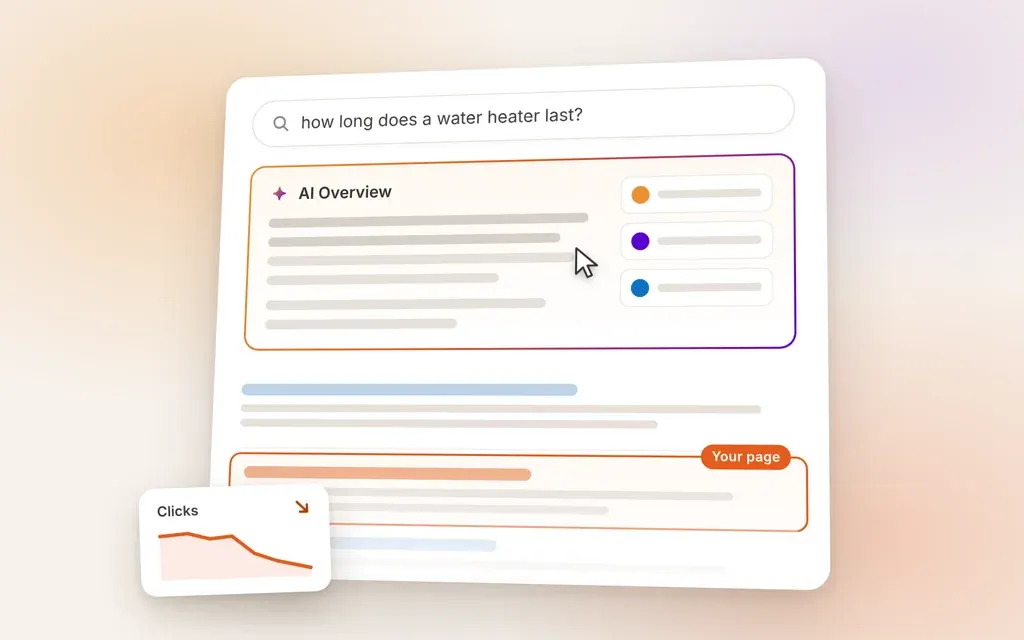
Yes. The strongest study so far, a 2026 randomized experiment with over 1,000 Google users, found that organic clicks fell about 40% on searches where an AI Overview appeared. Other studies land between "half as many clicks" and "58% fewer," depending on what they measured.
For a small business, the more useful question is which of your searches get an AI Overview at all. Plain local searches, the "plumber in [city]" kind that turns into phone calls, mostly don't. Below: what each study found, why the numbers differ, and what to check on your own site.
What did the main studies find?
All three big studies found fewer clicks when an AI Overview shows, and only one of them could prove the AI Overview caused it. The table puts them side by side.
| Study | What it measured | Finding | How strong |
|---|---|---|---|
| Field experiment (Indian School of Business and Carnegie Mellon, 2026) | 1,065 US desktop Chrome users; a browser extension randomly hid AI Overviews for some of them for two weeks | Organic clicks about 40% lower where an AI Overview appeared (38% in the first draft, 39.8% in the revision) | Strongest: random assignment shows cause. Not peer-reviewed as of its July 2026 revision; desktop only |
| Ahrefs (February 2026) | Click-through rate for 300,000 keywords, December 2023 vs December 2025, desktop | The top result's click rate was about 58% lower on keywords with an AI Overview | Large sample, but a before-and-after comparison: shows a link, not cause |
| Pew Research Center (July 2025) | Browsing data from 900 US adults, March 2025 | People clicked a regular result on 8% of visits with an AI summary vs 15% without | Independent and careful; data is now over a year old |
The experiment, by Saharsh Agarwal of the Indian School of Business and Ananya Sen of Carnegie Mellon, is a working paper on SSRN. Because people were randomly split into groups that did and didn't see AI Overviews, it can say the AI Overview caused the drop, which the others can't. In its first draft, as Search Engine Journal reported, zero-click searches rose from 54% to 72% when the AI Overview showed.
Why do the numbers range from 38% to 58%?
They measure different things, so they aren't competing answers. The experiment counts all organic clicks per search. Ahrefs looks only at the click rate of the page in position one, which takes the biggest hit. Pew counts any click on a regular result during a visit.
- The top spot loses most. In Ahrefs' data, the loss shrinks down the page: about 58% at position one, 39% at position four and 19% at position ten. The top spot has the most to lose.
- Only top placement hurt. In the experiment's first draft, the AI Overview sat at the top of the page 85% of the time, and lower placements had no measurable effect.
- Older numbers were lower. Ahrefs' earlier study, from April 2025, put the top-result loss at 34.5%. Its February 2026 update, using December 2025 data, found 58%, though it measured click rate instead of raw clicks, so the two aren't strictly comparable.
Do AI Overviews show up on local searches?
Rarely on plain local searches, often on questions. In a 2025 Whitespark test of 540 searches for six kinds of businesses in Houston, Phoenix and Denver, searches with plain local intent ("personal injury lawyers in Phoenix") showed an AI Overview only 15% of the time. It didn't test "near me" wording separately. Informational searches showed one 92% of the time.
The map pack worked the other way. It appeared on 93% of the plain local searches and 6% of the informational ones. Mixed searches like "should I get a lawyer after a car accident in Phoenix?" showed an AI Overview 97% of the time and a map pack only 17%.
The revised experiment points the same way. According to Search Engine Journal's summary of the revision, the click losses were concentrated in informational searches, while navigational searches (looking for a specific site) and transactional searches showed no measurable change, though those samples were smaller.
So a dentist or plumber whose calls come from searches like "dentist in [city]" or "emergency plumber [city]" is mostly competing in the map pack, which sits largely outside this problem. The traffic at risk is the blog post answering "how long does a crown last?" or "why is my water heater making noise?"
Does being cited in the AI Overview bring clicks?
A few, but not many. In Pew's browsing data, people clicked a link inside the AI summary on just 1% of visits that showed one. Being cited puts your name in front of the searcher, which has value, but it won't replace the clicks the regular results lost.
Pew also found that people ended their browsing session on 26% of visits with an AI summary, compared with 16% without. For many searches, the summary is where the visit stops.
Google says there are no special requirements or markup for appearing in AI Overviews. To be shown as a link, a page has to be indexed and eligible to show a snippet in regular Search. Past that, a clear, direct answer gives Google something worth citing. Our guide on letting AI tools crawl your website covers the access side.
What does Google say about AI Overviews and clicks?
Google says total clicks are steady and the clicks it sends are better. In an August 2025 post, Google said organic click volume had been "relatively stable" year over year and that it was sending slightly more "quality clicks," meaning visits where people don't quickly come back to the results.
Google didn't publish figures to back either point. The revised experiment tested the quality claim directly and, per Search Engine Journal, found no significant difference in bounces or time on site between the two groups. Both things can be true at once: total clicks across the web can hold steady while the click rate on a given search falls, if people search more often.
What don't the AI Overview studies measure?
None of them measures phone calls, form leads or map-pack clicks, which is where many local businesses make their money. They also lean on desktop data (the experiment and Ahrefs), and Pew's data is from March 2025. Google's results have changed since.
Your site may also be losing clicks for other reasons. Google's November 2026 core update, seasonality and new competitors all move traffic too. Before blaming AI Overviews, check which searches lost clicks.
What should a small business do about it?
Start by finding out whether it's happening to you, then protect the pages that bring in customers.
- Look at Search Console by query. AI Overview traffic is reported under the Web search type in the Performance report, and Google doesn't break it out separately. Instead, in Performance, open the date filter, choose Compare, pick the last 3 months against the same period last year, then sort the Queries tab by the change in clicks. Question-style queries ("how", "why", "what") whose impressions held while clicks fell are the likely AI Overview losses.
- Search your top queries yourself. Note which ones show an AI Overview and whether you're cited. For your local money searches, our free local SERP checker shows the map pack and rankings from different spots in your area.
- Put your effort into the searches that bring customers. Service pages and your Google Business Profile compete mostly in the map pack and the regular results. Our guide to service pages that rank covers those.
- Make question content worth citing. Answer the question in the first sentence or two, add a detail only you know (a local price range, a real timeline), and keep facts current. If an AI Overview cites you, the searcher sees your name even when they don't click.
- Measure calls and leads, not just visits. A blog post that loses half its clicks but still brings the same number of calls is doing its job. Track phone calls and form fills from each page, for example with a call-tracking number on the page or a "How did you find us?" field on your form.
If you'd rather have someone check this for you, our AI search service looks at where your business appears in AI answers, and our SEO service covers the map pack and organic results.
Frequently Asked Questions
Is SEO still worth it with AI Overviews?
Yes, especially for the searches that bring customers. In Pew's data, only 8% of one- or two-word searches showed an AI summary, compared with 60% of searches that used a question word, so short service searches are far less exposed than how-to questions.
Can I stop my site from appearing in AI Overviews?
Google says preview controls such as nosnippet, data-nosnippet, max-snippet or noindex limit what Search shows from your pages, AI features included. They apply to your regular listings too, so for most small businesses being cited is the better goal.